
The Next OAC Meeting Will Be a Room Full of People Prompting Agents
The biggest shift may be a new verbal protocol for assigning agent work, adding context, and running dozens of studies at once.

We ran a two-hour work session with our MEP team and one or two software developers. By the end of it, we had generated somewhere between 10 and 20 pull requests. Many were reviewed, merged into the platform, and available to users that same day.
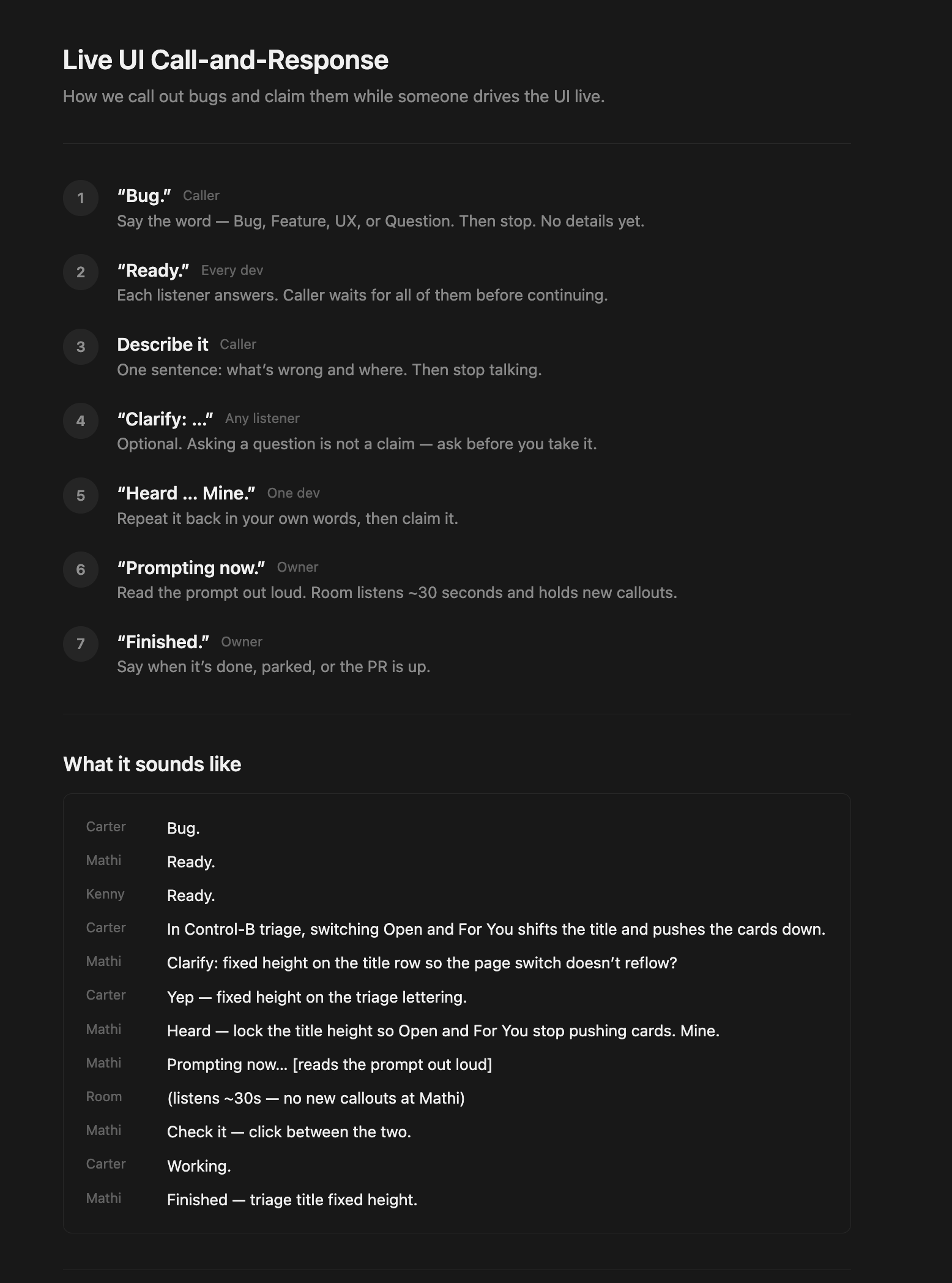
Image: our current verbal protocol for assigning live software work. The larger discovery was learning to hear one another prompt, add context, and keep multiple agents working without losing task ownership.
These were real changes to our engineering platform. Bugs fixed. Interfaces cleaned up. Features added. Work that would normally get written down, interpreted later, turned into tickets, prioritized, clarified, built, and eventually tested happened while the people experiencing the problem were still using the product.
The number of pull requests is crazy. The more interesting part is the verbal protocol we had to create to make the room work.
Someone using the product says, “Bug,” and then stops talking.
Every developer listening says, “Ready.”
The person describes the issue in one sentence. A developer repeats it back, says, “Mine,” and claims it. Then the developer says, “Prompting now,” and reads the prompt aloud while everyone listens. If someone has context to add, they add it before the agent starts working.
Then the agent goes under the hood and works while the rest of the room keeps moving.
It sounds small. It has changed how I think meetings will work in an agent-driven industry.
We are learning to co-prompt

AI work is moving into rooms full of people. Each person may own different agents, tasks, and areas of responsibility.
Internally, we spend a lot of time talking to agents. We also co-prompt. One person starts a prompt, another person hears it and adds a constraint, and someone else remembers a project condition that changes the whole direction. One person owns and monitors the task. The room helps build the prompt.
Sometimes the prompt is only partially formed when another person continues it on behalf of the first. We are actively riffing, talking, correcting, and sending agents off to do work. A good portion of the “typing” is becoming a live conversation among people who know that an agent is listening.
Reading the prompt aloud has become an important confirmation step. “I’m working on it” tells the room almost nothing. Hearing the actual prompt tells everyone what the person understood, what the agent is about to investigate, and whether an important piece of context is missing.
You can interrupt before ten minutes of agent runtime heads in the wrong direction.
You can say, “Add the ceiling height.”
Or, “Make sure it checks the adopted code year.”
Or, “The owner already rejected that manufacturer.”
The agent owner adds the context, launches the work, and keeps an eye on the result. Everyone else continues.

Every person in the meeting will have agents working
Now move this from a software session into an AEC design charrette.
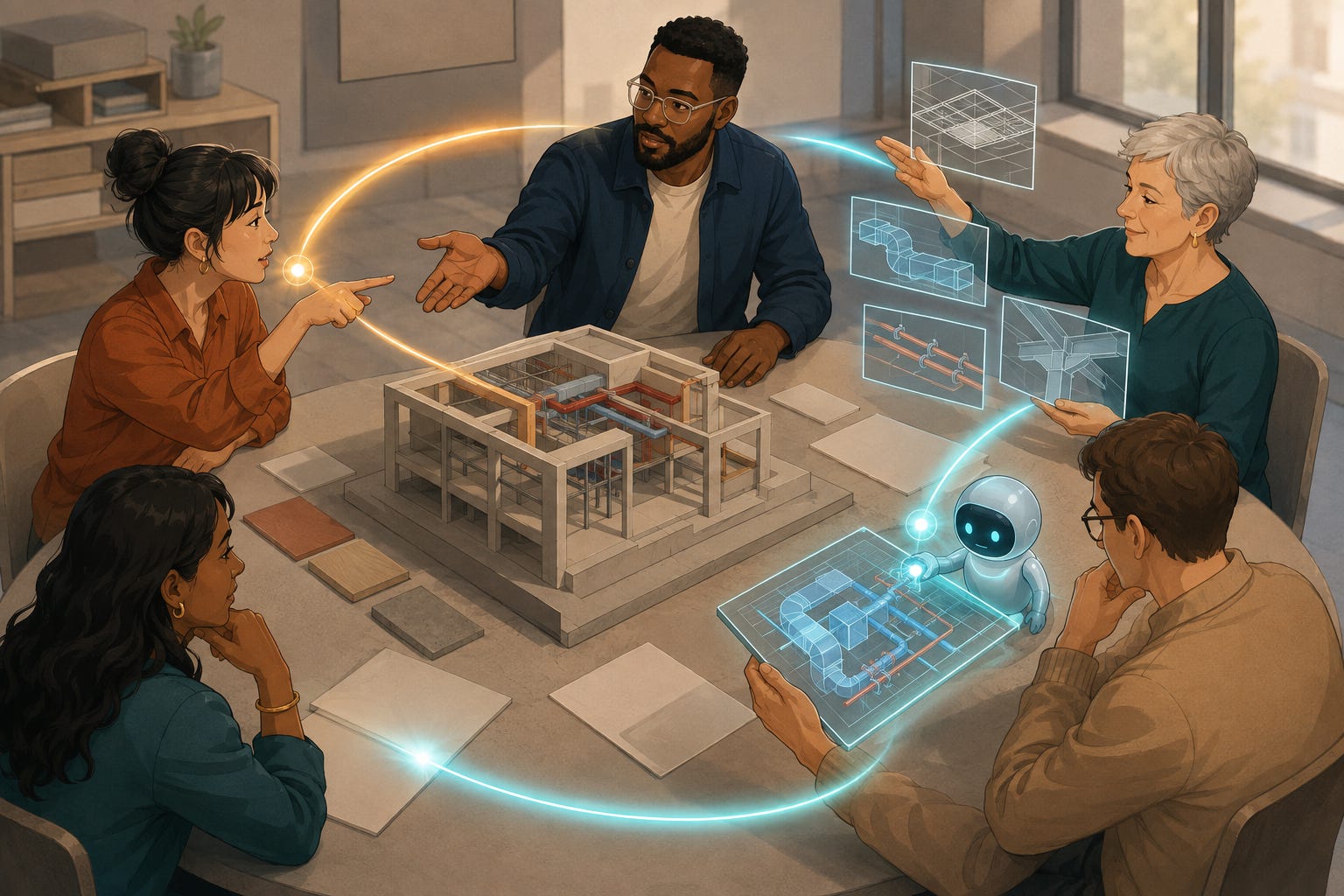
An architect identifies a coordination question. The MEP engineer says, “Listening.” The architect explains the issue while everyone can see the model. The MEP engineer repeats the task back, prompts an agent aloud, and monitors progress as the meeting continues.
A contractor sees a constructibility concern and sends an agent to compare installation approaches.
An estimator launches a pricing study.
An electrical engineer runs a load check.
A mechanical engineer asks an agent to test duct sizes against the available ceiling depth.
A plumbing engineer investigates a code question.
A project manager gives an agent an RFI, the relevant drawings, and the meeting context so it can assemble the first pass at a response.
A product representative’s agent searches the available manufacturer data against the actual design constraints.
Each person may have several tasks running for 10 or 15 minutes. The meeting continues while the agents work. Results come back into the room, get reviewed by the responsible professional, and either move the project forward or go back for another pass.
The room could complete an amount of study and coordination that used to spill into days of follow-up emails and separate internal meetings.
The important question becomes: Who owns each agent task?
Everyone needs to know who heard the request, who translated it into a prompt, who is monitoring the work, and who is responsible for judging the result. Agents can create a huge amount of motion. Clear ownership is what turns that motion into project progress.

Meetings will need a protocol
This future gets chaotic quickly without a shared way of speaking.
If five people launch agent work at once, the room needs to know what was claimed. If somebody adds context, the owner needs to know whether it was included. If an agent is still running, everyone needs to know whether to wait, move on, or park the issue. If a result comes back, a responsible person needs to review it before the room treats it as an answer.
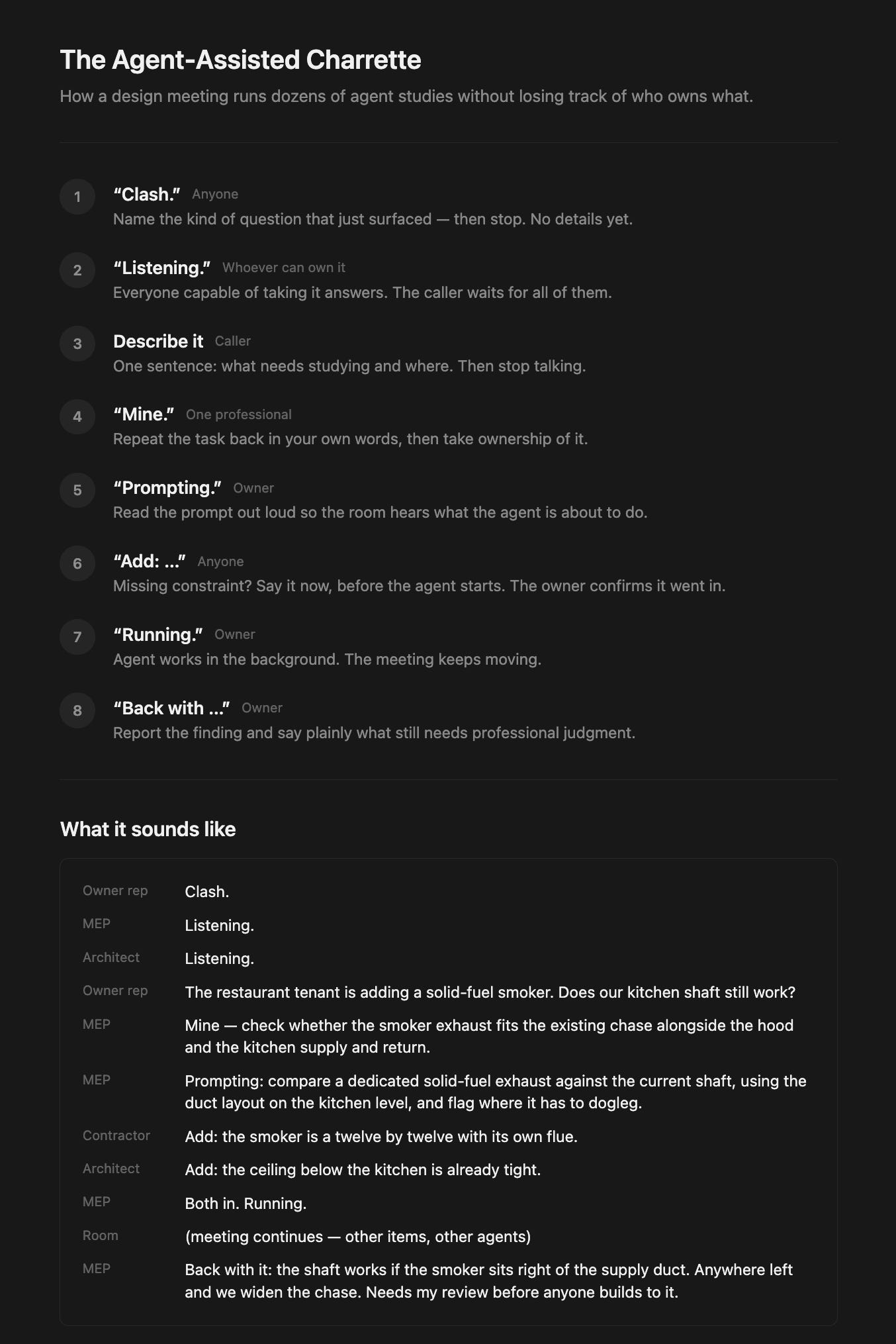
Image: proposed parallel protocol for AEC agent-integrated workflows
The protocol can be simple:
Call the task. Say what kind of issue has surfaced and stop.
Confirm listeners. The people capable of owning it respond.
Describe it briefly. State what needs to be studied and where.
Claim ownership. One person repeats the task and owns the agent work.
Prompt aloud. The room hears the prompt and adds missing context.
Launch and monitor. The owner runs the agent while the meeting continues.
Return with a result. The owner reports back, explains the finding, and identifies what still requires professional judgment.
The words will change by firm and discipline. The behavior is the useful part. Listen. Claim. Prompt. Add context. Launch. Review. Finish.
We had to develop this behavior to keep a live software session from becoming a pile of people talking over one another. The same behavior could allow an AEC team to operate dozens of agents during one design meeting without losing responsibility or context.
A protocol of action words we proposed is listed below.
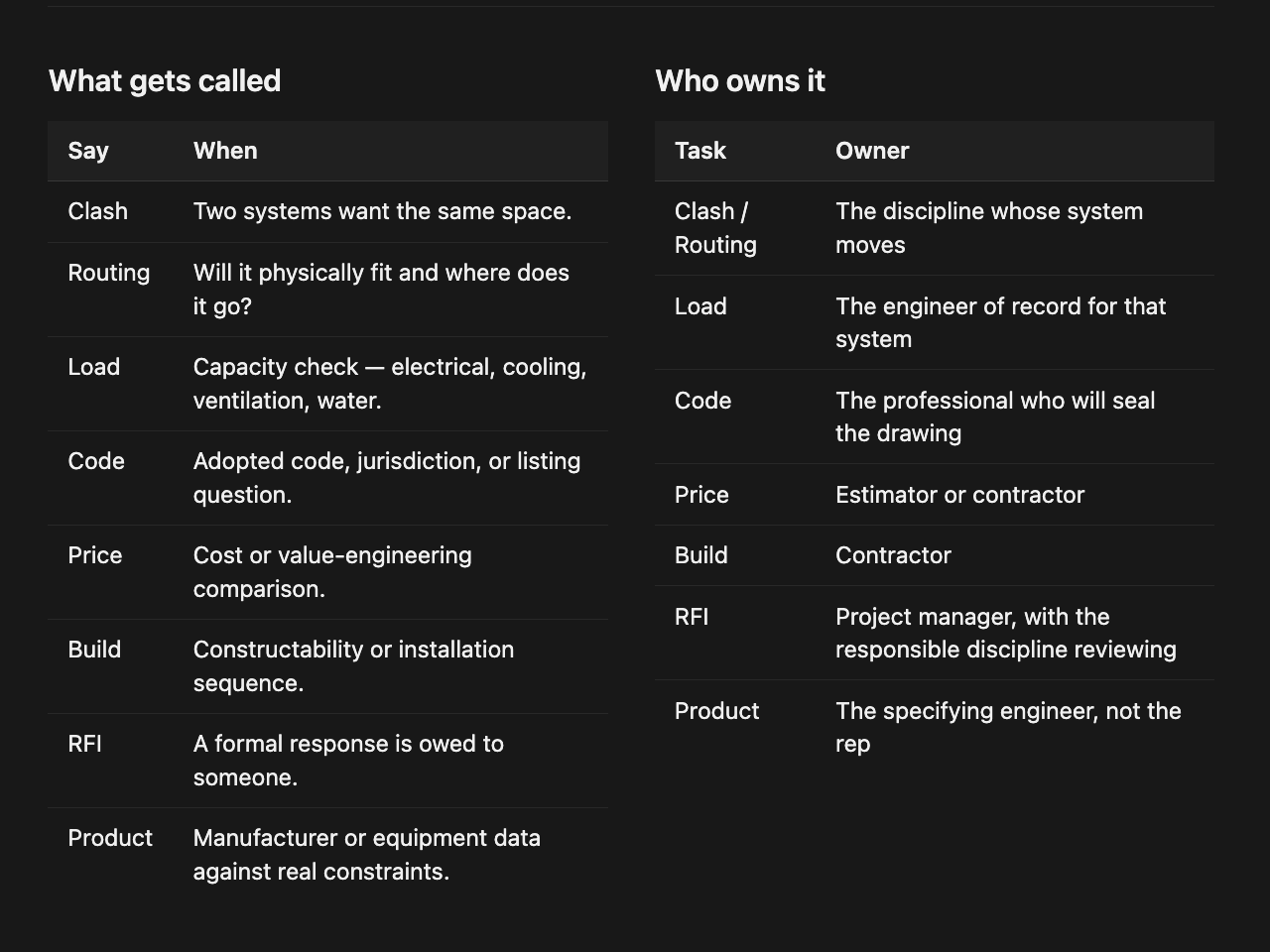
Image: proposed protocol and keywords for AEC agent-integrated workflows
PermitZIP is already working this way
We are already doing versions of this at PermitZIP.
Our team has agents. We talk to them. We hear one another’s prompts. We continue prompts for each other. We send multiple tasks to work while the team keeps moving. The live UI protocol in the image came from needing a practical way to manage that behavior with our developers and MEP users in the same room.
We can still get much better at it. Two hours producing 10 to 20 production pull requests feels ridiculous today. With a tighter protocol, better agent context, and more practiced people, that output can keep increasing.
AEC has a parallel opportunity. Imagine a two-hour charrette producing completed code studies, coordinated routing options, pricing comparisons, equipment research, first-pass RFI responses and submittal reviews, and tested design alternatives while the meeting is still happening.
People will get used to waiting while someone talks to an agent. They will get used to listening carefully to the prompt. They will get used to adding context before the work starts. They will get used to several agents running in the background while the human meeting continues.
The person still owns the task. The person still applies judgment. The room gains a new kind of workforce that can begin studying every question as soon as it comes up.
The firms that learn how to orchestrate that room are going to move projects forward at a pace that currently sounds a little crazy.
We know it sounds crazy because we are already watching it happen.