
Your HVAC Was Not Designed Around Your Desire to Be Cold
A 75°F office during peak summer is not automatically a failure. It may be the exact result of legal, code-compliant HVAC design.


PSA for anyone mad at their HVAC engineer or installer in Richmond today:
Your system was not designed to hold 68°F during peak summer.
It was not supposed to be.
It may not even be legal to design it that way.
Virginia energy code is clear:
For load calculations, the interior design temperature used for cooling cannot be lower than 75°F.
Not 72°F.
Not 70°F.
Not 68°F because someone likes it cold.
The code-compliant design basis starts at 75°F for cooling.

So if your office is sitting at 75°F to 78°F on a brutal summer day, that does not automatically mean something is wrong.
It means the system is doing exactly what it was legally designed to do.
The engineer did not miss your desire to be cold.
The installer did not magically override physics.
The code-compliant design basis is not “whatever temperature makes the owner happy.”
Cooling load calculations are based on required indoor design conditions, outdoor design conditions, occupancy, solar load, ventilation, envelope, equipment loads, and actual physics.
HVAC systems are not magic boxes that create unlimited cooling because somebody keeps pressing the down arrow on the thermostat.
The system was sized around a design condition.
The equipment was selected around a design condition.
The ductwork, airflows, controls, ventilation, zoning, and load assumptions were all built around a design condition.
If that design condition was 75°F indoors at the applicable outdoor design temperature (which is what Virginia energy code requires), then expecting the system to hold 68°F during peak summer is asking the system to perform outside the legal design basis.
Could there still be a problem?
Absolutely.
Bad airflow.
Bad balancing.
Bad controls.
Dirty filters.
Poor zoning.
Bad maintenance.
Undersized equipment.
A space being used differently than designed.
You were too cheap to buy the right equipment (most common).
All real.
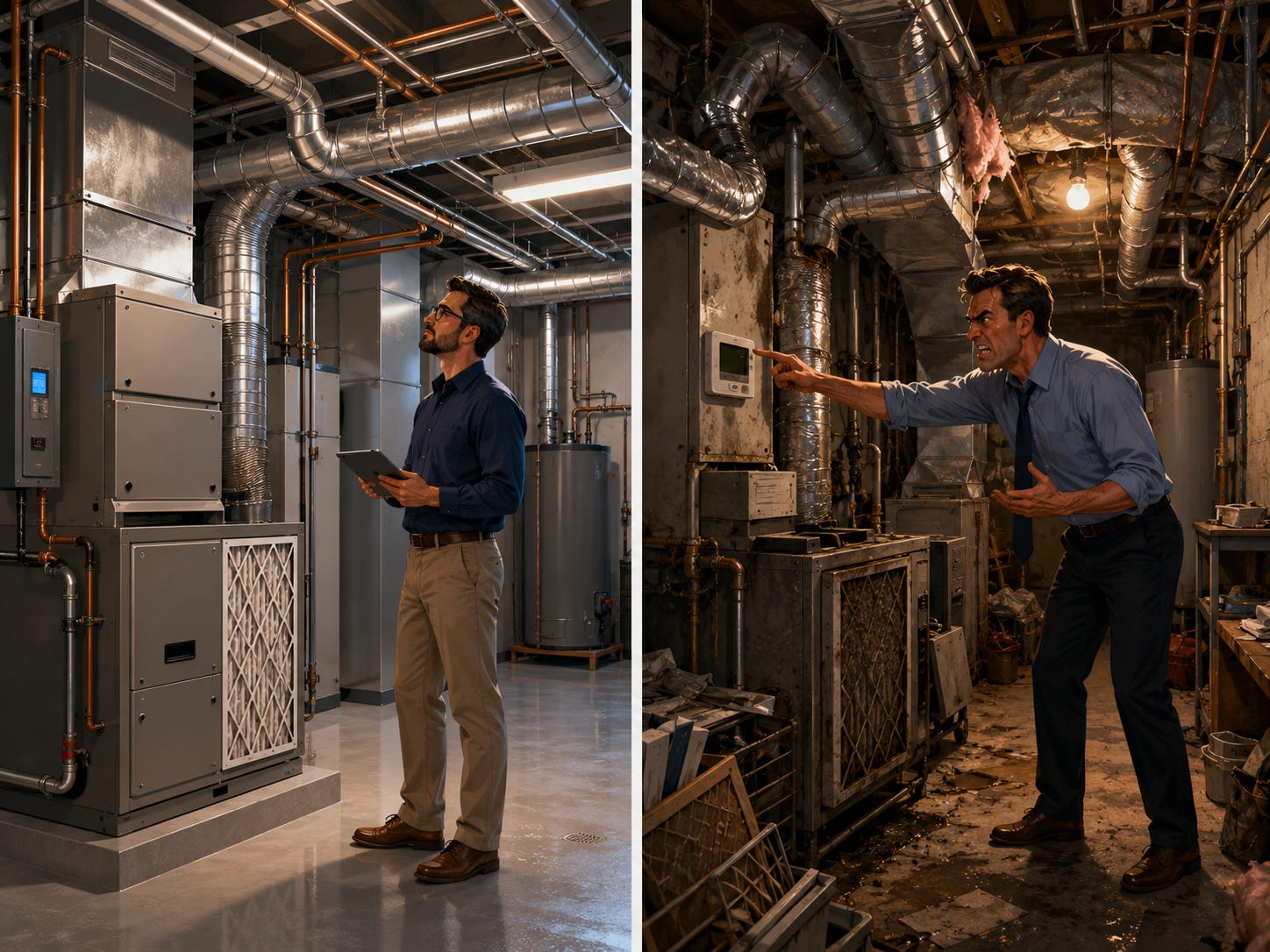
Those issues happen every day.
They should be investigated when the symptoms point that direction.
But “I want it to be 68°F when it is 98°F outside” is not evidence of bad HVAC design.
It is evidence that you do not understand the design basis.
There is a difference between a system failing and a system being asked to violate the assumptions it was legally designed around.
A building sitting at 78°F during extreme heat is not automatically a failure.
A tenant being uncomfortable does not automatically mean the engineer missed the load.
A thermostat setpoint does not rewrite the energy code.
And no, yelling at the installer does not change the outdoor design temperature.
Before blaming the engineer or installer, ask the only question that matters:
What indoor and outdoor temperatures was the system designed around?
That answer controls the conversation.
Not the thermostat setting someone wishes they had.
Not the owner’s preference.
Not the loudest person in the office.
The code and your budget set the design basis.

You may not like the answer.
But the code does not care about your comfort.